

Malta: residency, non-dom taxation and banking
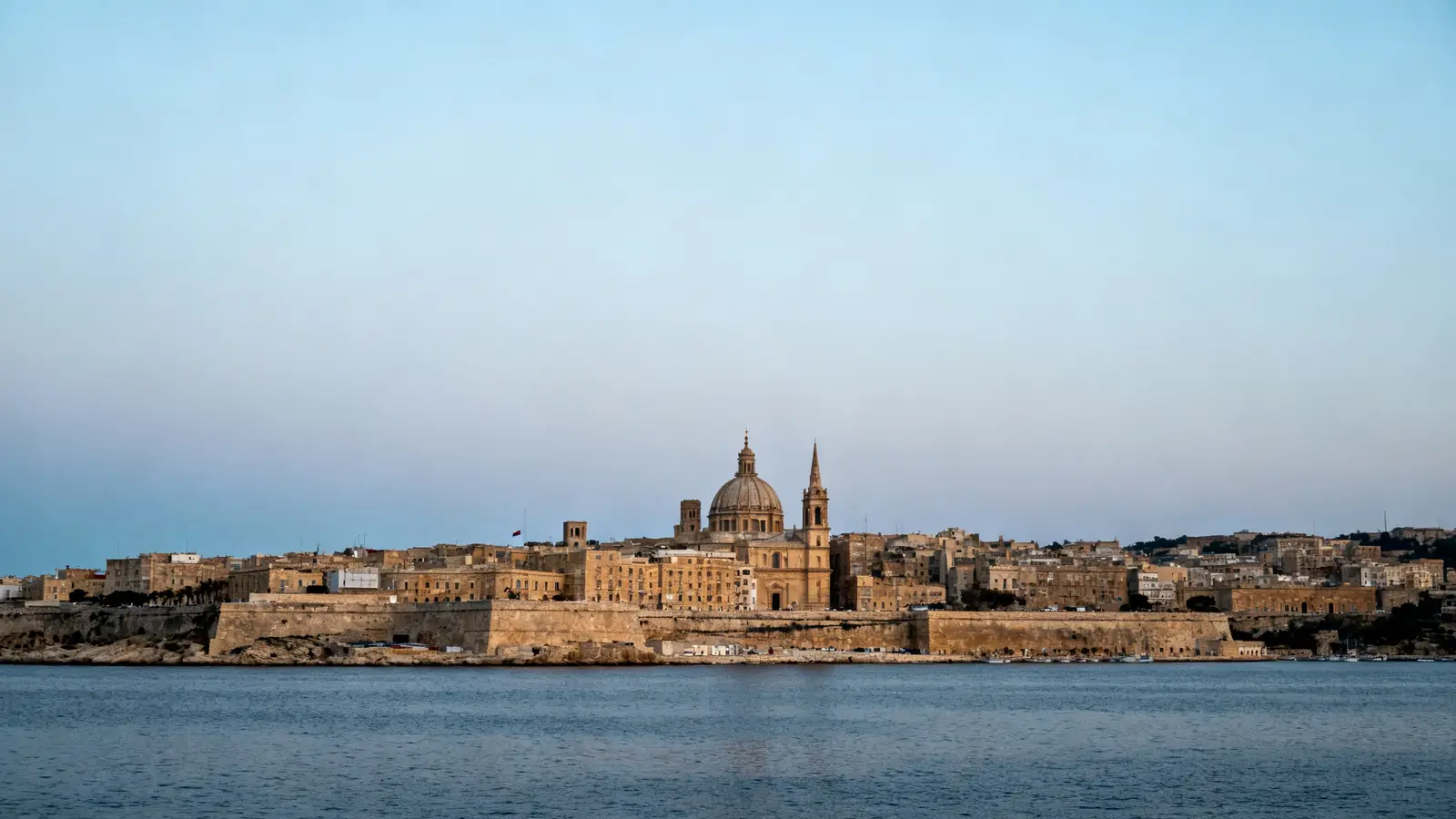
 MaltaEurope
- Tax residence (tax authority practice)
- More than 183 days in Malta in a calendar year, or from arrival when you move to settle
- As of 2026-10-25 · [6]
- Remittance basis for non-domiciled residents
- Foreign income taxed only when received in Malta; foreign capital gains not taxed
- As of 2026-10-25 · [7]
- Minimum tax for non-domiciled residents
- EUR 5,000 a year where foreign income is at least EUR 35,000
- As of 2026-10-25 · [7]
- Personal income tax 2026, single rates
- 0% up to EUR 12,000; 15% / 25%; 35% above EUR 60,000
- As of 2026-10-25 · [8]
- Corporate income tax
- 35%; a 6/7 shareholder refund usually applies to distributed trading profits
- As of 2026-10-25 · [19]
Overview
Malta suits people who want a settled European base more than the lowest possible tax bill: non-EU families looking for a permanent right of residence, remote workers employed abroad, retirees with foreign pensions and founders prepared to live on the island. English is an official language alongside Maltese, and a Maltese residence card allows visa-free travel in the Schengen Area for up to 90 days in any 180.
Personal taxation turns on domicile. A resident whose domicile stays abroad is taxed on Maltese income and on foreign income received in Malta, while foreign income left abroad and foreign capital gains fall outside the charge. Where such a resident's foreign income reaches EUR 35,000, a minimum annual tax of EUR 5,000 applies unless a special programme sets its own minimum.
2026 is a transition year. The schemes that tax remitted foreign income at a flat 15% move into the Individual Tax Programme on 1 January 2027, with higher minimum taxes and property thresholds; statuses granted or applied for by 31 December 2026 keep the current terms until the end of 2031. Malta's investor citizenship route closed in July 2025 after a ruling of the EU Court of Justice.
Redomiciled sequences the move and the paperwork, while Maltese advocates and warranted tax practitioners give the legal and tax advice on each file.
- Flat-rate tax statuses from 2027-01-01
- 15% kept; minimum tax EUR 35,000; home from EUR 700,000 or rent from EUR 14,000 a yearAs of 2026-10-25 · [12]
Malta residency and permanent residence by investment
Malta residency for non-EU nationals usually comes through the Malta Permanent Residence Programme, the Global Residence Programme or the Nomad Residence Permit. As of 2026, the MPRP grants permanent residence against a EUR 37,000 contribution and a qualifying home bought or rented in Malta.
The MPRP is open to non-EU, non-EEA and non-Swiss nationals with capital assets of at least EUR 500,000, of which EUR 150,000 in financial assets, or EUR 650,000 with EUR 75,000 in financial assets. Applicants pay a EUR 37,000 government contribution and a EUR 2,000 donation to a registered Maltese NGO, and either buy a home for at least EUR 375,000 or rent one for at least EUR 14,000 a year, keeping it for five years. Files go through a licensed agent, and approval rests with the Residency Malta Agency after multi-tier due diligence.
MPRP status is permanent and can cover up to four generations, but it carries no right to work and no tax status of its own: employment needs a separate permit, and tax follows the ordinary residence and domicile rules. Since 2025 applicants may request a one-year temporary residence permit at the start of the process.
Non-EU nationals who want a flat rate on foreign income have used the Global Residence Programme, and EU, EEA and Swiss citizens its twin, The Residence Programme. Foreign income remitted to Malta is taxed at 15% with a minimum of EUR 15,000 a year, against a home bought for at least EUR 275,000 (EUR 220,000 in the south of Malta or Gozo) or rented for EUR 9,600 a year (EUR 8,750). Pensioners can use the Malta Retirement Programme, with a minimum tax of EUR 7,500 plus EUR 500 per dependant.
From 1 January 2027 these schemes become statuses under the Individual Tax Programme Rules: the 15% rate stays, but the minimum tax rises to EUR 35,000 (EUR 15,000 for pensioners), the property test to EUR 700,000 or EUR 14,000 a year in rent, and each status runs for five renewable years. Statuses granted or applied for by 31 December 2026 keep the current terms until 31 December 2031.
Remote workers employed or contracted outside Malta can apply for the Nomad Residence Permit with gross income of at least EUR 42,000 a year. It is issued for one year and can be renewed three times, up to four years in total, provided you spent at least five of the previous twelve months in Malta. Income from the remote work is untaxed in Malta for the first 12 months and then taxed at 10%.
Applications run through licensed agents and authorised mandataries, and Maltese advocates and tax advisers give the legal and tax opinions; we coordinate the steps around them.
Who it suits
Non-EU families seeking permanent EU residence
You want a lasting Maltese residence right for up to four generations, with Schengen travel, and can meet the capital and property tests.
Investors living on foreign income
Your income arises abroad and you want the remittance basis or a flat-rate status, with a Maltese home as your main residence.
Remote workers employed abroad
Your employer or clients sit outside Malta and you want a renewable permit for up to four years.
Retirees with foreign pensions
Your pension makes up most of your income and you plan to spend a real part of each year on the island.
Requirements
- Required
Qualifying home in Malta
Bought or rented at or above the programme threshold; for the tax programmes it must be your main residence worldwide and may not be sublet.
- Required
Due diligence on every adult
Criminal record and source-of-funds checks for all applicants; nationals of sanctioned countries are excluded.
- Required
Health insurance
Cover for risks in Malta and across the EU for each family member.
- Required
Capital or income
Capital assets for the MPRP, stable resources for the tax programmes and EUR 42,000 gross a year for nomads.
- Required
Licensed agent or authorised mandatary
MPRP applications are filed through a licensed agent; special tax status applications through an authorised registered mandatary.
- Depends on your case
Time spent in Malta
Varies by route: five of the last twelve months for nomad renewals, more than 90 days a year on average for pensioners, and the facts of your stay for tax residence.
Documents
- Passports for every applicantComplete copies, including blank pages where the agency asks for them.
- Police conduct certificatesRecent originals from each relevant country, translated into English where needed.
- Proof of funds and source of wealthBank statements, asset schedules and evidence of how the wealth was built.
- Lease or deed for the Maltese homeShows the qualifying property and the address that will appear on the residence card.
- Health insurance policyAnnual cover for every applicant, running for the validity of the card.
- MPRP contribution
- EUR 37,000 contributionContribution due within 8 months of approval in principleAs of 2026-10-25 · [2]
- MPRP qualifying property
- Purchase from EUR 375,000 or rent from EUR 14,000 a year, kept for 5 yearsSame thresholds in Malta and GozoAs of 2026-10-25 · [1]
- MPRP capital assets
- EUR 500,000 incl. EUR 150,000 financial, or EUR 650,000 incl. EUR 75,000 financialAs of 2026-10-25 · [1]
- MPRP donation and dependant contribution
- EUR 2,000 NGO donation; EUR 7,500 per adult dependant other than the spouseAs of 2026-10-25 · [1]
- Global Residence Programme (applications up to 2026-12-31)
- 15% on remitted foreign income, minimum tax EUR 15,000; home from EUR 275,000 (EUR 220,000 south/Gozo) or rent from EUR 9,600 (EUR 8,750)The Residence Programme mirrors it for EU, EEA and Swiss citizensAs of 2026-10-25 · [10]
- Malta Retirement Programme (applications up to 2026-12-31)
- 15% on remitted income; minimum tax EUR 7,500 plus EUR 500 per dependant; pension at least 75% of chargeable incomeMore than 90 days a year in Malta, averaged over 5 yearsAs of 2026-10-25 · [11]
- Individual Tax Programme from 2027-01-01
- Minimum tax EUR 35,000 (EUR 15,000 for pensioners); home from EUR 700,000 or rent from EUR 14,000; 5-year statusEarlier statuses and applications keep current terms until 2031-12-31As of 2026-10-25 · [12]
- Nomad Residence Permit
- Gross income from EUR 42,000 a year; 1 year, renewable to a maximum of 4 yearsAs of 2026-10-25 · [4]
- Nomad income tax
- 0% for the first 12 months, then 10% on income from the remote workAs of 2026-10-25 · [5]
Timeline
- 1Choose the routeCompare the MPRP, the flat-rate tax statuses and the nomad permit against your income, family and the 31 December 2026 cut-off.
- 2File the applicationThe licensed agent or mandatary submits the file.
- 3Due diligence and approval in principleThe agency or the tax commissioner reviews every applicant; approval rests with them and can be refused.
- 4Property, contribution and insuranceSign the deed or lease, pay the MPRP contribution within eight months of approval in principle and arrange health cover.
- 5Biometrics and residence cardAll applicants travel to Malta to record biometrics, after which the residence cards are printed and issued.
Tax notes
- MPRP holders have no special tax status: once resident they fall under the ordinary rules, which for non-domiciled residents cover Maltese income plus foreign income remitted to Malta.
- Non-domiciled residents with foreign income of at least EUR 35,000 pay a minimum of EUR 5,000 a year unless they hold a special tax status; a married couple is assessed together.
- Special tax status holders pay 15% on remitted foreign income and 35% on Maltese-source income, and the programme minimum is payable in full in the first and the last year.
- Expatriates hired into eligible senior roles, for example in financial services, gaming or aviation, can apply for a 15% flat rate on qualifying salary under the Tax Treatment of Highly Skilled Individuals Rules, subject to a salary floor.
General information, not tax advice. Your position depends on your circumstances.
Banking fit
- A Maltese account in your own name supports the residence file, and nomads use its statements to show time spent in Malta at renewal.
- Banks ask source-of-wealth questions that mirror the residence due diligence, so one consistent document set serves both.
- Electronic money institutions can cover day-to-day payments while a bank account is pending; every provider applies its own checks.
Questions
What investment does Malta permanent residency require in 2026?
The MPRP requires a EUR 37,000 contribution, a EUR 2,000 NGO donation and EUR 7,500 for each adult dependant other than the spouse. You also need a home bought for at least EUR 375,000 or rented for at least EUR 14,000 a year.
How are non-doms taxed in Malta?
Residents domiciled abroad pay tax on Maltese income and on foreign income brought into Malta, at normal rates up to 35%. Foreign income kept abroad and foreign capital gains are not taxed. A minimum tax of EUR 5,000 applies once foreign income reaches EUR 35,000.
What changes for the Malta Global Residence Programme in 2027?
From 1 January 2027 it becomes Global Resident Status under the Individual Tax Programme Rules. The 15% rate stays, but the minimum tax rises to EUR 35,000 and the property test to EUR 700,000, or EUR 14,000 a year in rent. Statuses granted or applied for by 31 December 2026 keep current terms until 2031.
What income do you need for the Malta digital nomad visa?
At least EUR 42,000 gross a year from an employer, your own company or clients outside Malta. The permit lasts one year and can be renewed three times. Income from the remote work is untaxed for the first 12 months and taxed at 10% afterwards.
Can MPRP holders work in Malta?
Not automatically. The residence certificate does not include an employment licence, so a beneficiary who wants a job or self-employment applies through the normal work permit procedures. Setting up a business is possible under the general rules.
Can Malta permanent residence lead to citizenship?
Possibly, but not as of right. MPRP holders may apply for naturalisation after five years of residence, including the full year before the application; the minister decides at discretion, and since July 2025 no investment-based route exists.
Banking in our network
We do not publish institution names: the right partner depends on your profile, and each institution keeps its own view on who it will serve.
5
Banking partners
- Malta's banks and electronic money institutions work within EU rules, and onboarding is document-heavy: expect detailed source-of-funds and source-of-wealth questions and timelines that can run longer than in larger EU markets. Each institution decides on its own due diligence.
- Personal accounts are usually easier once you hold a Maltese residence card and a local address. Companies need a registered office in Malta and, where the owner lives abroad, a director based on the island.
- Five institutions in our Malta network, corporate banks and electronic money institutions, review introductions; the banking assessment is the starting point.
Questions
Does Malta still offer citizenship by investment?
No. On 29 April 2025 the EU Court of Justice ruled that Malta's investor naturalisation scheme breached EU law, and Act XXI of 2025 replaced it in July 2025 with naturalisation on merit, decided case by case. Permanent residence through the MPRP remains available.
How many days do you need in Malta to be tax resident?
There is no single statutory day count. The tax authority treats anyone present for more than 183 days in a calendar year as resident, and someone who moves to settle as resident from the day of arrival. The special programmes add their own presence rules.
Can EU citizens move to Malta without a residence programme?
Yes. EU, EEA and Swiss citizens staying longer than three months register with Identità and receive an eResidence document, generally valid for five years, with no fee for first registration. A flat-rate tax status is optional and has its own conditions.
Sources
- 1.Residency Malta Agency: Malta Permanent Residence Programme (MPRP), retrieved 2026-10-25
- 2.Legal Notice 146 of 2025: Malta Permanent Residence Programme (Amendment) Regulations, retrieved 2026-10-25
- 3.Residency Malta Agency: MPRP frequently asked questions for licensed agents, retrieved 2026-10-25
- 4.Residency Malta Agency: Nomad Residence Permit FAQs, retrieved 2026-10-25
- 5.Nomad Residence Permits (Income Tax) Rules, S.L. 123.210, retrieved 2026-10-25
- 6.Malta Tax and Customs Administration: Tax residence, retrieved 2026-10-25
- 7.Malta Tax and Customs Administration: Guidance note on the remittance basis of taxation, retrieved 2026-10-25
- 8.Malta Tax and Customs Administration: Tax rates for individuals, 2026, retrieved 2026-10-25
- 9.Malta Tax and Customs Administration: Special schemes for individuals, retrieved 2026-10-25
- 10.Global Residence Programme Rules, Legal Notice 167 of 2013, retrieved 2026-10-25
- 11.Malta Retirement Programme Rules, S.L. 123.134, retrieved 2026-10-25
- 12.Individual Tax Programme Rules, 2026 (Legal Notice 195 of 2026), retrieved 2026-10-25
- 13.Malta Tax and Customs Administration: Company income tax, retrieved 2026-10-25
- 14.Court of Justice of the EU: Press release 52/25, Commission v Malta (C-181/23), retrieved 2026-10-25
- 15.Maltese Citizenship (Amendment) Act, Act XXI of 2025, retrieved 2026-10-25
- 16.Identità: EU nationals, residence registration FAQs, retrieved 2026-10-25
- 17.Identità: Non-EU employment and self-employment FAQs, retrieved 2026-10-25
- 18.PwC Worldwide Tax Summaries: Malta, individual taxes on personal income, retrieved 2026-10-25
- 19.PwC Worldwide Tax Summaries: Malta, corporate income determination, retrieved 2026-10-25
- 20.KPMG Malta: The Global Residence Programme, retrieved 2026-10-25
- 21.Redomiciled internal notes: Malta structuring and relocation (internal), retrieved 2026-10-25
- 22.Redomiciled internal notes: residency and citizenship by investment overview (internal), retrieved 2026-10-25
Reviewed by the Redomiciled team on .
Plan your next step in Malta.
Answer a few questions and we come back with a recommendation for your situation, without obligation.