Argentina's Passport From USD 350,000: The Best Money Can Buy?


My take
Argentina's new passport, once it's available, might be the best passport money can buy. Most traditional CBI programmes are open to anyone who has the money and can pass the due diligence. Because of that, banks and payment providers can be more sceptical when onboarding people with those passports, and it's also why more and more countries have been cutting visa-free access for CBI passports.
Argentina is different. It's a large country with a big population, so when a bank sees an Argentine passport, it will usually assume you naturalised or qualified by descent, not that you bought it. For the same reason, a government is unlikely to change its visa requirements for Argentine nationals because of a very small number of CBI passports compared with the size of the population.
The main thing to be aware of is that the programme isn't open yet. The decree behind it still has to get past the Supreme Court, and we'll see how that goes as public opinion on the current president keeps shifting. So you can't act on it straight away, but if this is a passport you want, it's worth considering now and starting to prepare.
What people are underestimating is how hard it will be to get once it opens. Argentina is a country with real history and pull, so demand will be high and the programme will likely be oversubscribed. That gives the government room to be selective, and it will be. Argentina will want to give citizenship to the kinds of people it actually wants as citizens, not just anyone who can pay.
We've spent a good part of the last couple of months in Argentina, and we really understand why someone would want to be a citizen here. If you have the wealth and the profile Argentina is looking for, this is a great opportunity. Below is how I'd think it through.
Argentina's citizenship by investment (CBI) is a planned route to naturalisation for foreigners who make a qualifying investment, without the usual two years' residence. Announced by the Ministry of Economy on 2 October 2026, it offers two options: a non-refundable USD 350,000 Treasury contribution or a USD 800,000 government bond. Applications are expected from the fourth quarter of 2026.
Playing the video loads it from YouTube (youtube-nocookie.com).
What did Argentina actually announce?
On 2 October 2026, Economy Minister Luis Caputo and Chief of Cabinet Diego Santilli presented the programme at Argentina Week in Paris. As far as we know, that makes Argentina the first country in South America to offer citizenship by investment. The legal base is an emergency decree from May 2025, which added naturalisation through 'relevant investment' to the citizenship law, and a July 2025 decree that sets out the procedure.
There are two ways in for the main applicant:
- Donation: USD 350,000 paid to the national Treasury. It is not returned.
- Bond: USD 800,000 into a government bond created for the programme. On the terms we have seen, it pays no interest and is returned after seven years. The government has not yet published the full bond terms.
The USD 350,000 covers the main applicant only. On the donation route, family members cost extra:
- Spouse: USD 100,000.
- Each child aged 18 to 25 (single, with no children of their own): USD 100,000.
- Each child under 18: USD 25,000.
So a couple with two young children pays around USD 500,000 in total. I think most people will take the donation: it's simpler, the bond terms aren't published, and tying up USD 800,000 for seven years is a big opportunity cost.
What are the two mistakes people are making?
Mistake one: thinking it's already open. Applications are due to open in the fourth quarter of 2026, but no date has been set. The amounts come from the ministry's announcement and have not yet appeared in the official gazette.
Mistake two: thinking that if you have the money, you get the passport. Money alone won't get it for you. Under the July 2025 procedure, a Ministry of Economy agency assesses the investment and consults the security, intelligence and financial-intelligence bodies. If any of them advises against it, the agency must recommend rejection. The National Directorate of Migration then makes the decision within 30 business days of the agency's report.
What does an Argentine passport actually get you?
The passports for sale usually come from small islands. This one is different in four ways.
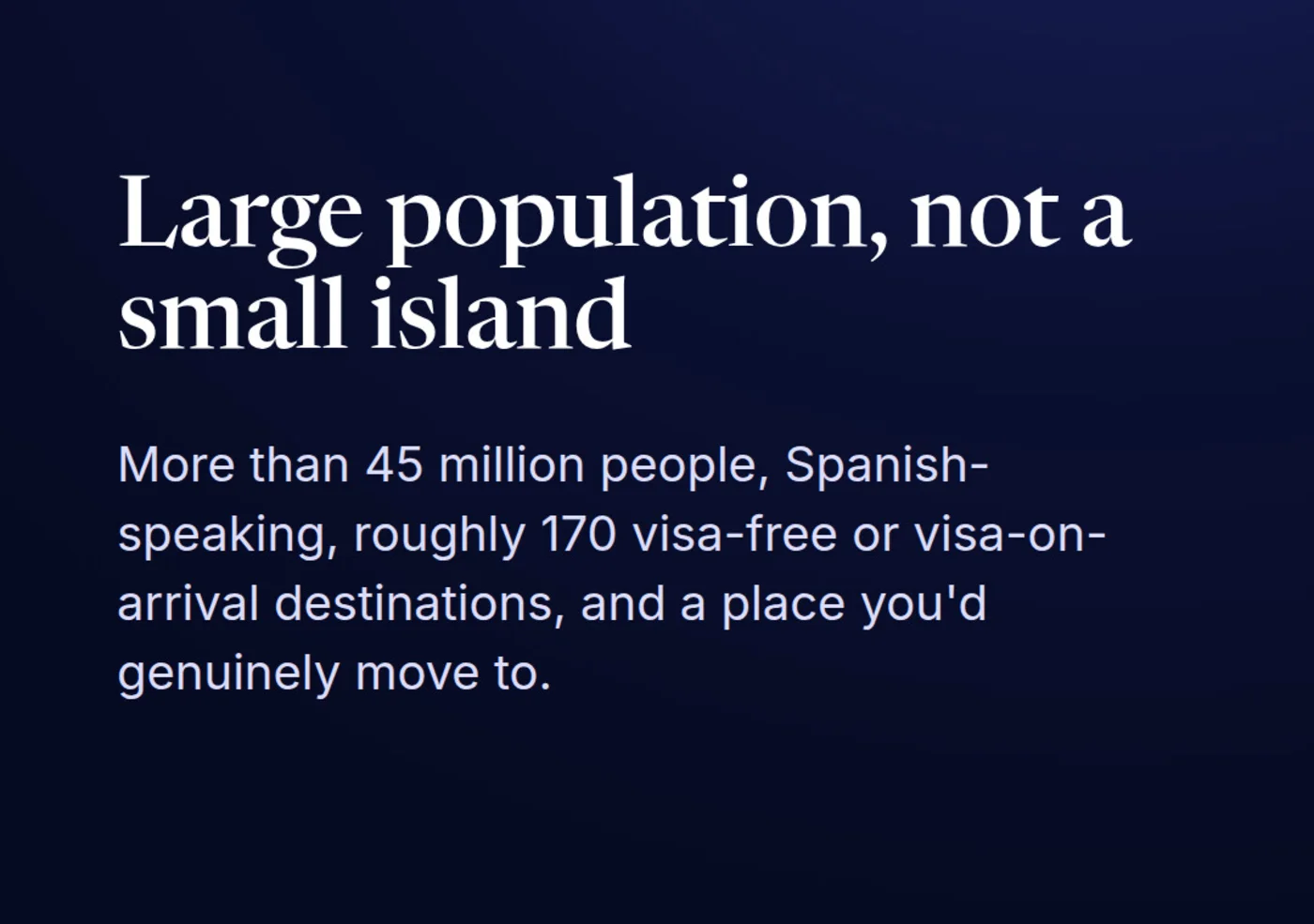
- A passport from a country with a large population, not a small island. Argentina has more than 45 million people, a real history, Spanish as its language and a strong European heritage built on European migration. The passport opens visa-free or visa-on-arrival travel to roughly 170 destinations, Europe and the UK included. Once you have held Argentine nationality for five years, the Mercosur residence agreement also gives a simple route to live and work across much of South America.
- You blend in. Europe is getting more sceptical of bought passports. The EU has asked Antigua and Barbuda to phase out its programme by June 2028 or risk losing visa-free access to Europe, and Antigua's prime minister says the same pressure applies to the other Eastern Caribbean programmes (CMC/Jamaica Observer, July 2026). In a country this size, nobody can tell whether your passport was bought or came through ordinary naturalisation. In our experience, that means fewer extra questions from banks than a passport everyone knows was bought.
- The right to live here. This is a lifestyle passport: it gives you the right to live in Argentina full time. Getting residency here is not easy and nothing like Paraguay or Uruguay. It normally means a rentista visa, where you show a steady income, or setting up a business. The passport skips that step.
- It doesn't make you a tax resident on its own. Argentina is not a light-tax country. But under a March 2026 change to the income tax law, a foreigner naturalised through a relevant investment is not treated as tax resident because of the naturalisation alone. If you already held permanent residence here, you stay tax resident. Moving here full time is a different matter, and our guide to the 183-day rule explains why.
Most people buying a Caribbean passport don't want to live in the Caribbean. They buy it for optionality. With Argentina, you pay a premium, but you get the optionality without the stigma, plus a country you'd genuinely move to.
Argentina? What about the inflation?
It's a fair point. Argentina has a long history of inflation and capital controls. But nowhere is immune, Europe included.
More to the point, a passport doesn't tie you to Argentina financially. Your assets can stay where they are. Would I move my entire business or personal treasury into Argentine pesos? Probably not. But that's not what this is. The idea is to spread across a few geographies so that nothing happens to everything at once.
What could still stop the programme?
Risk one: the court case. The programme came in by emergency decree, not through Congress. Argentina's constitution is built around equal treatment, and the critics' argument is that citizenship should be earned the same way by everyone, not bought. In June 2026 two appeal courts ruled that the decree's citizenship changes don't stand up: the federal civil and commercial appeals court and the National Electoral Chamber. The Electoral Chamber held that citizenship is tied to political rights, which an emergency decree cannot change, so the decree's transfer of the decision from judges to the migration authority does not stand.
Neither case was an investment application, and each ruling binds only its own case. The government appealed, and on 24 September 2026 the Electoral Chamber allowed the appeal to go to the Supreme Court. Until the Supreme Court rules, nobody knows whether the programme stands.
Risk two: politics. In my view, support for the government has softened, and opposition deputies have filed bills to repeal the investment route. None has passed, and the government has appealed the rulings and is pressing ahead with the launch. So the real question is timing: how long the courts take, and how long this government stays in power to get the programme running.
In your favour: once passports like this are issued, it is rare for them to be taken away. Argentina is very bureaucratic. Things come into force slowly, and they are taken out of force slowly too. I'd be surprised if there were problems once passports are actually issued. Still, programmes like this don't always last.
Others have been struck down or closed, and people who got passports before a programme closed generally kept them:
- Malta: the European Commission took Malta to court, and on 29 April 2025 the EU Court of Justice ruled that its investor citizenship scheme breached EU law.
- Cyprus: shut its programme from 1 November 2020, after a television investigation exposed abuse of the scheme. Most kept their passports, but by September 2025 Cyprus had moved to revoke citizenship from about 360 investors and family members who did not meet the rules, one more reason a clean file matters.
- Montenegro: opened with a cap of 2,000, received around 1,100 applications and closed at the end of 2022.
People who had been thinking about it for years simply missed out. That's exactly why I wouldn't be the first to send USD 350,000. Wait for the Court to rule, and get yourself ready in the meantime.
Is Argentina's passport right for you?
Every passport suits a different use and a different type of person. I'd ask four questions.
- Do you need a second passport soon? If yes, don't wait for Argentina. The Caribbean programmes are open today: if you have the money and pass due diligence, they can usually move within months, though the EU is pushing them to wind down.
- Is USD 350,000 a big chunk of your net worth? If yes, this probably isn't the one for you. Spending that much of your wealth on one passport is hard to justify.
- Do you just want a plan B, or a base in the region? If yes, Paraguay and Uruguay already have very open residency programmes for a few thousand euros. We compare them in our Latin America residency guide.
- Could you show where every dollar came from, on paper? If you answered no to the first three, you might be who this programme is built for, and this question settles it. It's where most applications get into trouble.
How do you get ready before it opens?
Think of it like a private members' club with the fee printed on the door. Paying the fee is the easy part, because the committee still reads your file. What decides it is how the application is presented, and four things carry most of the weight:
- Source of wealth: how you made your money in the first place. Every source of income documented, nothing unexplained.
- Source of funds: how this specific money got to where it is now. If you sold a business five years ago, they will follow the money from the sale to the account you pay from today. The most common problem we see is money that moved through several accounts in different countries, with no paper trail connecting them.
- Your companies: ideally established businesses with audited financial statements.
- Your banking: a long-standing bank that can give you a reference letter, ideally a private banker who knows you and can speak to your family's finances.
Then the basics: passports and personal documents in order for everyone on the application. A paper trail is an asset, because good records today are your source-of-wealth evidence in five years. This is what we do day in, day out: banking, source of wealth, structuring and documents, all in one place, through our wealth planning work.
Once it opens, you're in the queue with everyone else, and it could fill up quickly. Pulling all of this together can take months, so if you know you'll want a passport in a few years, start now.
What I'd actually do
If you need a passport soon, or you mainly want a plan B, I wouldn't wait for a court in Buenos Aires. Look at the Caribbean programmes that are open today, or start with residency in Paraguay or Uruguay, which costs a fraction of this.
If you would genuinely live in Argentina one day and USD 350,000 is a small part of your wealth, I'd start building the file now and wait for the Supreme Court before sending a dollar. With Argentina, the money is the easy part. The people who get this passport will be the ones who were ready before it opened.
We work with passport and residency programmes around the world and with over 170 partner banks, so we can help with the banking and source-of-wealth side too. We're close to the people working with the government on this programme; we follow the rollout closely, but decisions rest with the government. Getting a file like that together across countries, companies and banks is where most people get stuck.
Frequently asked questions
Is Argentina's citizenship by investment open yet?
No. It was announced on 2 October 2026 and is due to open in the fourth quarter of 2026, with no date yet. The decree behind it still has to get past the Supreme Court.
How much does it cost for a family?
On the donation route, a couple with two children under 18 pays around USD 500,000: USD 350,000 for the main applicant, USD 100,000 for the spouse and USD 25,000 per child.
Will banks treat it like a bought passport?
Usually not. Argentina is a country with a large population, so a bank will usually assume you naturalised or qualified by descent.
Will the passport make me an Argentine tax resident?
Not on its own. Naturalisation through investment does not by itself make you tax resident. Moving there full time is a different matter.
Sources
- Boletín Oficial de la República Argentina: Decree 524/2025, procedure for citizenship through relevant investment (as of July 2025)
- Diario Crónica: Ministry of Economy launch of the Citizenship by Investment Programme, amounts and family contributions (as of October 2026)
- Forbes Argentina: How the USD 350,000 citizenship programme will work (as of October 2026)
- Morrone Abogados: Golden Visa Argentina, programme status, gazette publication and court rulings (as of November 2026)
- Chequeado: Citizenship by investment and why the courts are questioning it (as of October 2026)
- Infobae: The Supreme Court will review the decree that changed how citizenship is granted (as of October 2026)
- Allende & Brea via abogados.com.ar: Labour Modernisation Law, citizenship by investment and tax residence (as of March 2026)
- Argentine government legal database: Law 25,902 approving the Mercosur residence agreement (as of July 2004)
- Jamaica Observer (CMC): EU calls on Antigua to phase out its citizenship by investment programme (as of July 2026)
- European Commission: Report on the suspension of the visa exemption for nationals of Vanuatu, COM(2024) 366 (as of May 2024)
- Dominica News Online: UK imposes visa requirement on Dominica nationals over citizenship by investment concerns (as of July 2023)
- The Rio Times: Henley Passport Index 2026 rankings for Latin America (as of January 2026)
- INDEC via Canal 26: Census 2022 population results (as of January 2023)
- AGP Law: EU Court of Justice judgment in Commission v Malta, Case C-181/23 (as of April 2025)
- Gulf News (AFP): Cyprus scraps investor passport scheme (as of October 2020)
- Cyprus Mail: Cabinet moves to revoke 28 more 'golden passports' (as of September 2025)
- GLOBALCIT: Montenegro renews its investor citizenship programme (as of January 2022)
- Radio Free Europe/Radio Liberty: Montenegro golden passports after the programme's closure (as of November 2023)
This article is general information, not legal, tax or financial advice. Views in the "My take" and opinion sections are the author's own. Redomiciled coordinates with licensed local providers.
Ready to structure your global life?
See our articles first in Google Search.